

Who Doesn't Love a Good Slap in the Face?
Thoughts on depolarization, pluralism, and the promise of America
This is a version of a talk I gave at a right-wing think tank. I would happily give it at any lefty space that would have me—though admittedly, while I was up there, I forgot to look at my notes and also couldn’t suppress the urge to indulge my deepest unmet desire, which is to do stand-up.
Afterwards, a woman came up to me and said, “I didn’t agree with most of what you said, but I love that you said it. I just love a good slap in the face.” The best compliment I’ve ever gotten.

I begin with a question: How many of you have gone into the gender rabbit hole and met someone there whom you otherwise wouldn’t have come into contact with? How many of you have found your worldview expanded through working on this issue?
If you haven’t, please find someone here who has and talk to them about that experience.
For some of you here, that person is me: a lefty, feminist, hairy-armpitted, fiercely pro-choice atheist Jew. A right-wing think tank is the only place in America where I’m a diversity hire.
I have the honor—and it is an honor—of being equally reviled by hard-core TERFs and hard-core trans activists, and that is because I am not loyal to any one group; I’m loyal to nuance, and the pursuit of truth—and I will never again choose belonging over truth.
Let me explain how I came to do the opposite, and why.
In 2007, a very good friend of mine published a book about trans teens; I had hooked her up with my agent. She and her partner (this was before gay marriage was legal) became the foster parents of a homeless trans girl. In 2009, I met a socially transitioned nine-year-old very feminine male, living as a girl; he would go on to partake of the full medical path, and seems to be thriving today. I had no reason to be skeptical of the idea of the trans kid, or the medication to treat them.
Then, in 2015, another good friend of mine made a documentary for PBS about trans kids, and suddenly I did feel skeptical. Why, I wondered, were all these young, gender nonconforming kids—kids I’d have assumed were gay—now trans? I had no answers, but in 2017, I wrote an op-ed for The New York Times asking why people assumed my own young, gender nonconforming kid was trans, and was subsequently introduced to the vicious experience of cancel culture. Suddenly, I was a transphobe, a bigot, and a child abuser.
Terrified, shamed, concerned, and confused, I set about trying to understand why so many people had reacted so vehemently to my mild-mannered piece . I met with my friend who wrote the 2007 book, and she told me to ignore much of what those in the resistance had told me. Then, I sat down for a two-hour coffee in the Financial District with one Chase Strangio, who told me to abandon all nuance, because the right-wing would co-opt it.
Well, that turned out to be true. But it was a terrifying prospect: the equivalent of treason.
At the same time, I also learned of an underground resistance brewing, of 4th Wave Now, of ROGD, of social contagions. I mentioned this to my editors, who agreed there might be something there, but they would not let me write about it.
So I wrote an entire book not telling the whole truth, and kept reporting with that skepticism like a nagging midge buzzing around me. There were good things about that time, especially because my self-censorship allowed me to talk to movers and shakers of gender-affirming care, like Jack Turban, Diane Ehrensaft, and Caitlyn Ryan, which I could only do because of what I’d suppressed.
Then I interviewed Ken Zucker, who told me about the desistance literature, and finally the nagging skepticism made sense. Why did those kids in the 2015 documentary seem gay? They probably were! It had taken me four years to get enough information not only to feel like I understood the issue enough to tell the truth, but to feel like I was going to explode if I didn’t.
But by that time, the media was so polarized that I couldn’t break through for my modest goal: diversify the media narrative. Because I knew that if I could present a multifaceted narrative, that if I could push it beyond left/right, the other skeptics would feel free to dissent. I knew that, for real liberals, who are by nature pluralists, viewpoint diversity was the way to break the enforced fealty.
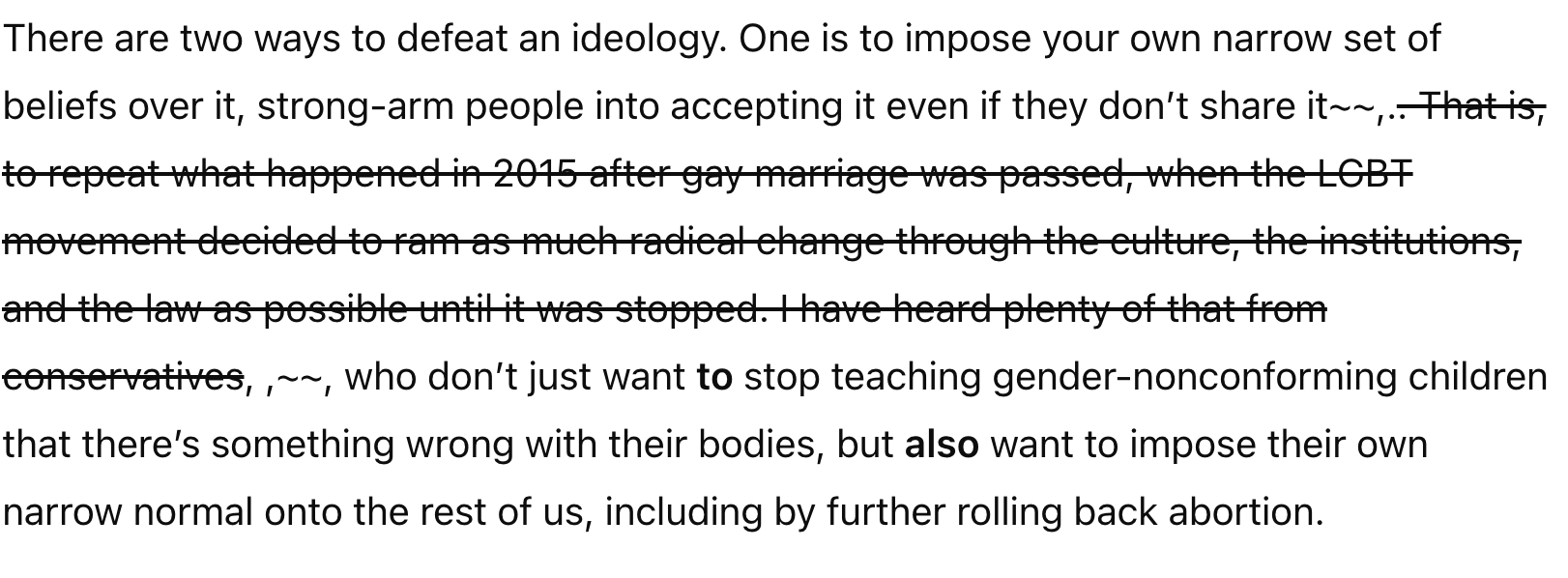
There are two ways to defeat an ideology. One is to impose your own narrow set of beliefs over it, strongarm people into accepting it even if they don’t share it,. That is: to repeat what happened in 2015 after gay marriage was passed and the LGBT brigade decided to ram as much radical change through the culture, the institutions, and the law as possible until it was stopped. I have heard plenty of that from conservatives, who don’t just want to stop teaching gender nonconforming children that there’s something wrong with their body, but impose their own narrow normal onto the rest of us, including further rolling back abortion.
Without having had an abortion 32 years ago, I would not be standing here today, I wouldn’t have given birth to the child I desperately wanted, who emerged as gender nonconforming and sent me on this long trek to understand the lack of room for her in this iteration of liberal culture.
The other way to defeat an ideology is to offer the off-ramps of viewpoint diversity, critical thinking, debate, disagreement—to create an environment in which people feel comfortable questioning their beliefs. Because the ideology isn’t just about gender. It’s the belief that because our side does it, it’s right.
This is an ideology that grew in a culture of polarization. If we want to defeat it, we have to depolarize. If we want to defeat it, we have to create an environment in which people can dissent without risking the most human need, which is to belong.
Because it was the censorship around the issue that incubated it. I’m here today to urge you to help me create that environment. One way to do that is to talk about this issue, and about the people who hold these beliefs as close to their heart as some of you hold your beliefs in god, in a way that invites the quiet skeptics to speak up.
Another way is to do what I have done relentlessly for the last four years: hold your own side accountable for its excesses. Don’t assume that because Republicans or Trump do it, it’s good—tariffs, regime change, or even telling people they can’t serve in the military because they subscribe to a belief system.
I’m not on the side of angels. I’m on the side of your right to believe that angels exist, and my right not to believe that. I’m on the side of sex is real and boys and girls can look and act all kinds of ways.
If this issue has brought you in touch with people who think differently, then, please, try to do the same. The human is probably the only animal that can occupy the viewpoint of someone from a different tribe. This is the closest thing I have to a spiritual practice.
Some liberals came through gender and went all the way over to the other side, to become just as certain of their own rectitude. They continue the circular reasoning that something is right because their side says it’s right, or right because God says it’s right. I am not moved by that logic.
I came through and found myself communing with people I’d been taught were bad and wrong because of their group affiliation, people who have shown me so much grace and kindness, whose prayers I welcome. I love these conversations—and I recognize that most people need a tribe and don’t like wandering alone in the vast tundras of heterodoxy like I do.
But I want you to see the ideology as rooted in polarization, and help me to create an environment in which more liberals can commune, in which more of you can understand the liberal perspective, in which we can move from an America of relentless swinging from one ideological extreme to another, into what it really could be: a pluralistic and tolerant society, with laws and policies that respect our individual sovereignty while holding us to group norms, and biological realities.
Working on this issue has been the most dismaying, difficult and rewarding thing I’ve ever done—other than having children. I love ideological tourism, and I highly recommend it.
PS: Here are ChatGPT’s copyedits:
Great piece, Lisa. I love your relentless quest for pluralistic dialogue, and I share your experience of getting flak from both sides on a range of issues.
On the trans issue, I have to admit that after learning everything I could about this topic, I don't see much of a middle ground anymore. While I don't share the attitude of some on the gender critical side that all heterosexual trans-identified men are disgusting fetishists to be reviled, and I obviously think the people who have been caught up in that belief system and have irrevocably altered their bodies must be treated with compassion, and that adults should be free to believe themselves to be whatever they want, I do not think that there should be any forced societal participation in their beliefs - i.e. no access for males to female spaces, no teaching in schools about "gender identity", no insurance coverage for "gender affirming" interventions. No social pressure to pretend that "being trans" is an innate condition rather than a coping mechanism for other issues. So where is the middle ground to be found?
The problem with viewpoint diversity around the trans issue is that it is inherently at odds with a live-and-let-live approach, because nobody can "be trans" without societal endorsement of and participation in their belief system. Saying "sure, you can believe that you are really a woman even if you were born with a male body, but I won't pretend that is true" to a trans-identified person equals violence to them, the erasure of their very existence. Due to their belief's fundamental dependence of social affirmation, they will never agree to disagree, and allow you to view their belief as a creed as valid as the faith in the Trinity or the Immaculate Conception, which they are free to hold while you do not partake. They NEED us all to partake, and so viewpoint diversity on this issue is fundamentally impossible due to the inherent demands of the belief system itself.
I love the concepts of pluralism and viewpoint diversity—for things like city budgets, or literature, or aesthetics. But I’m not sure they’re as useful in some circumstances. Do we want such disagreement on basic concepts, such as killing is wrong? Of course there’s plenty of disagreement about what kind of killing is wrong and which is okay. But my point is that having moral certainty about an issue isn’t always a bad thing—it can be a good thing.