

We Have a Ken Jennings Problem
On obviousness and obliviousness
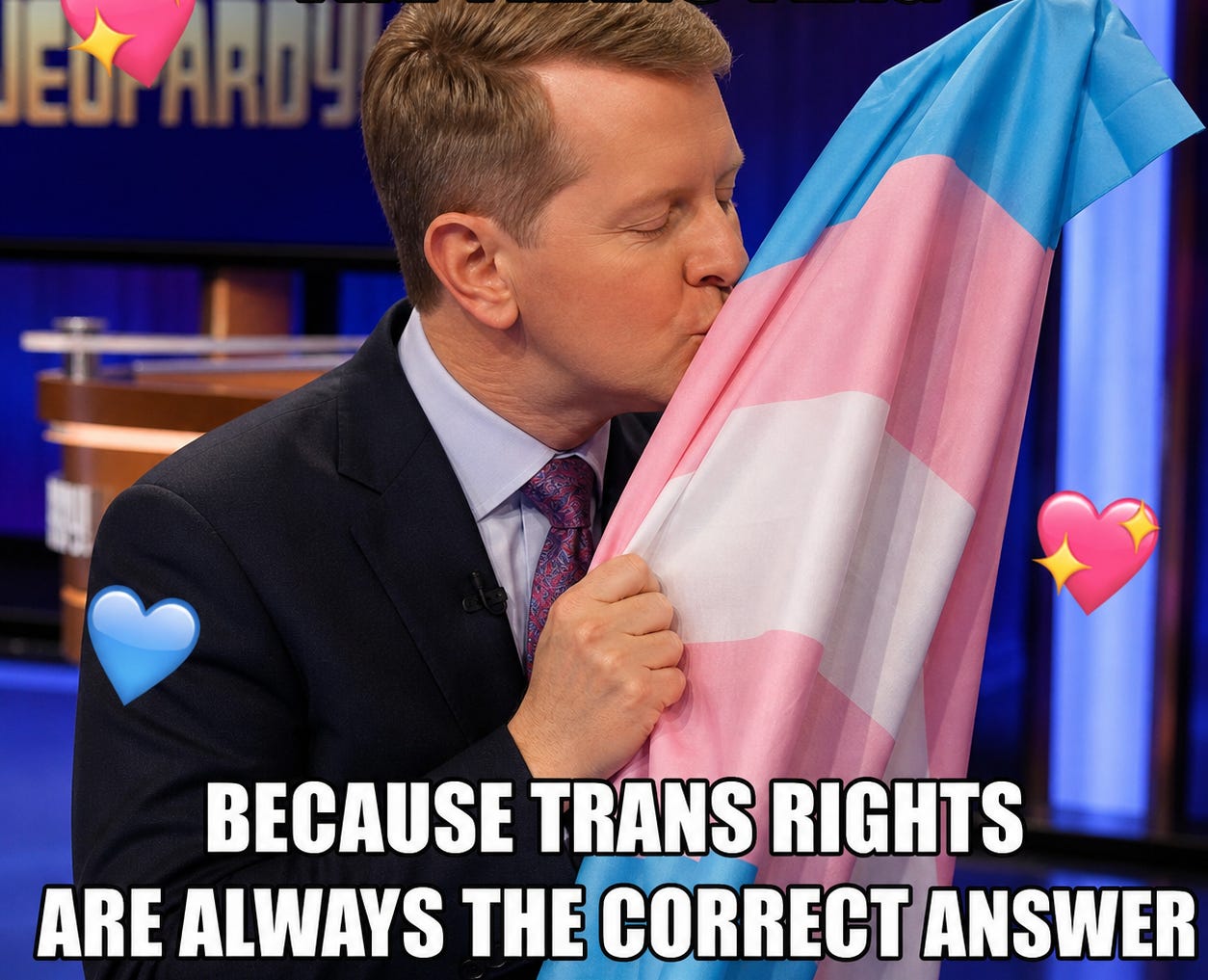
Ken Jennings, current host and former champion of Jeopardy!, arguably knows more about almost any subject than, well, almost any other human being. One subject he does not know a lot about, though, is youth gender medicine. Nor does he seem to understand that lived experience is not higher in value or relevance than evidence—at least when it comes to this subject.
His misunderstandings were tidily captured in a post on Bluesky:
To break this down: Jack Turban is a psychiatrist who began publishing research on gender dysphoric youth while still in his residency—research that he claimed showed that, say, offering puberty blockers to youth reduced mental health issues later, including suicidality. Thus, he concluded, puberty blocking treatment should “be made available for transgender adolescents who want it.”
By 2024, nonpartisan bodies in several countries, including Finland, Sweden, and England, had found that Turban’s studies, and many others, were so methodologically flawed that one could draw no conclusions about the potential benefits of any gender-affirming treatments, from social transition to penectomy. In fact, the more evidence excavated over the last decade, the less clear it became what’s being treated; how to tell if the treatments worked; and what to do if they didn’t. We have no solid definition of gender identity, let alone what it means to affirm it. It does seem that affirming a gender identity, or facilitating gender identity, increases the possibility of intensifying gender dysphoria later, or of an identity persisting that might otherwise have faded. But do we know for sure?
We do not.
Just because there’s no solid evidence of benefit and clearer evidence of harm doesn’t mean that affirming clinicians (or parents) are abusers. So, yes, when Texas AG Ken Paxton recently declared affirmation to be abuse, Turban weighed in, insisting that Paxton had it wrong.
As I’ve noted before, sterilizing children is considered abuse by Texas lawmakers, thus one could credibly accuse those who sterilize children in the name of identity—as opposed to, say, avoid dying of cancer—of abuse. But there seem to be only small numbers of those having reproductive organs removed, or going straight from blockers to hormones without passing through endogenous puberty, who are thus sterilized via transition. Thus, Paxton was probably catching a lot of garden variety affirmers in his lasso.
Anyway, Jesse Singal, OG gender science journalist, who’s done some of the most important reporting on the Turban-style weak research, weighed in, to poke at Turban for continuing to insist that all major medical associations put out the same messaging.
Then Erin Reed, a male who transitioned and identifies as a woman—and who has a very popular Substack that has been elevated as credible by other news organizations, like The Nation—weighed in, accusing Singal of cozying up to Paxton, which apparently caught Jennings’ eye.
For a guy who assumes the role of Nicest Fella On Any Soundstage, Jennings’ remarks oozed with smarm. He assumed Singal’s upset stemmed from experts disagreeing with him, and that because they were experts, they were right.
That appeal to authority is flawed—it’s the evidence that matters, not the person talking about it. But it was Jennings’ self-righteous certainty that reminded me just how far we have to go in getting normie liberals to understand what that evidence says, and that the experts are so financially and emotionally invested in presenting the flawed research they’ve generated as flawless that, actually, they’re not trustworthy to present the evidence. To Jennings, it is completely obvious that Singal is wrong because he has come to a different conclusion than Jack Turban and Erin Reed.
And that’s how it is for most libs out there. Obvious. Obvious that it’s a left/right issue. That if any Republicans champion it, it can’t be right—factually or morally. That gender identity is real and unchallengeable and that trans kids have always existed and are in grave danger of suicide if not affirmed and that it is the kind thing to do to participate in their affirmation.
What else could the explanation be??
Well, the answer to that question is what I’ve been writing up for the last couple of years. But while I’m waiting for feedback on it, I welcome your attempts to answer it yourself. Why else would all those experts with degrees be disagreeing with Jesse Singal? And how do we get people like Jennings to see that he not only has the answer wrong, he has the question wrong, too?
PS: Enjoy these track changes from ChatGPT.

"And how do we get people like Jennings to see that he not only has the answer wrong, he has the question wrong, too?" Excellent framing, given the context!
Jeopardy’s “top female” player of all time is a biological male. I stopped watching when they chose to affirm his delusion and erase a woman’s hard earned stat.
Jennings is obnoxious, too.