

The Closing of Hampshire College Is an Opening for a New Model University
A fond-ish, grateful, sad, and mad farewell to my alma mater
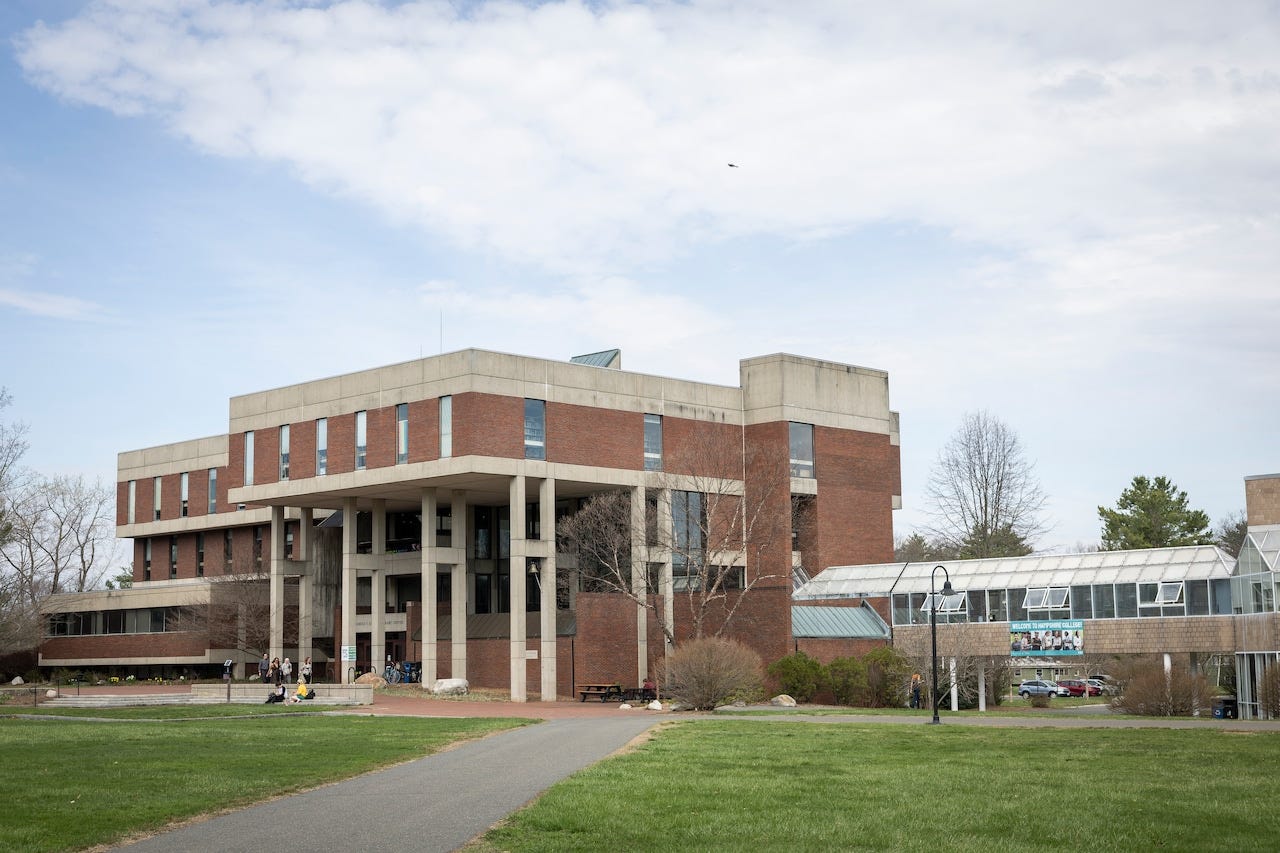
My happiest two weeks in college occurred when my dog Taj came to live with me in my “mod”—the name for the group houses most students lived in at Hampshire College, after our first year in the dorms.1
With apologies to those who mistakenly believe their dogs were the best, it was Taj who was actually the greatest to ever walk the face of the earth. The perfect sized mutt at 40 pounds, with long russet hair, floppy ears, and a fluffy tail, Taj was both fiercely loyal and fiercely independent. Thus, he entertained himself while I was in my various classes during my second year, in 1990, and met me at the door of each building when I was done. When my dad and stepmom returned from vacation, they picked him up. It wasn’t long after that history’s greatest dog left us for good.
That my most contented moments relied on canine companionship illustrates just how lonely and lost I was at Hampshire, but also how great their pets-on-campus policy was—at least for those of us who didn’t abuse and/or abandon our pets, which ended up happening with such increasing frequency that the pets policy was abolished a year or so later. Some of Hampshire’s more revolutionary policies left us for good, too, as the revolution couldn’t quite be sustained.
The idea for Hampshire College came from the presidents of its neighboring schools: Amherst, Mount Holyoke, and Smith Colleges, and the University of Massachusetts Amherst. They wanted “to reexamine the assumptions and practices of liberal arts education.” Founded in 1965, the first class arrived in 1970.
Since then, Hampshire helped launch a lot of brilliant people who thrived in its alternative environment, from Ken Burns to John Krakauer, Lupita Nyong’O to Liev Schreiber. Forging partnerships between once-siloed disciplines; allowing students to design their own majors; narrative evaluations instead of grades; making us write papers or craft projects over and over until they were good, rather than just accepting a middling grade—those were all great things, and very unusual at the time.
But I’d gone there not because I was desperate for that alternative education—my public high school, three miles north, had allowed me to concentrate mostly on ceramics and pot-smoking for three-and-a-half years, after which I arranged to graduate, mid-senior year. Alternative was mainstream to me. I went to Hampshire because my mother worked there. It was free. She had become a college librarian so that her kids would someday be able to go to college without having to secure a full-ride merit scholarship, as she did (and which I couldn’t). I’ve been called a nepo baby because of that free tuition, but for most of my life, I had a single mom with a low-paying job, whose folk musician ex often failed to pay child support. She might not have chosen wisely in marriage, but the job was a shrewd move.
It wasn’t until thirty years later that I found a reason to use the phrase “cultural hegemony.” In writing a book about the youth gender culture war, I finally understood the power of an ideology to cripple a party.
My discontent at Hampshire didn’t stem from a lack of cool people around me. In fact, maybe I was too surrounded by cool people—or just so many who were their high school’s most eccentric pupils that it rendered me, by comparison, awkwardly normal. Or maybe it was just that I was encased in constant shame about my body, as many young women are. I would have been unhappy anywhere.
So it was something of a relief when, whatever class I signed up for—The Psychology of Oppression, The Frankfurt School, the History of Sensationalism—it manifested into some version of Images of Women in the Media. Much of the curricular content served to explain my misery: magazines made me feel bad.
We were critiquing institutions and ideologies that themselves had sprouted from critiques of institutions and ideologies. The world was faulty and revolutions had failed and that’s why I felt so bad about my thighs and so few people wanted to date me. (It couldn’t be that I had an undiagnosed personality disorder, extremely low self-esteem, and a lot of unpressed childhood crap—if that’s not the making of a winning personals ad, I don’t know what is.)
Of course, I wasn’t aware that I was partaking of an ideology at an institution myself. We weren’t studying what our professors’ critiques were critiquing, the traditions against which they rebelled. We were studying their rebellions. I ended up getting a degree in, essentially, experimental feminist video and neo-Marxist theory, but I didn’t study the filmmaking behind Citizen Kane or take economics, as my professors had. The opening of Overton window was clear—and narrow.
As I’ve begun touring colleges with my own daughter, I’ve become aware that we need quite another educational revolution….It’s really hard to justify spending the equivalent of the price of a home to be educated to regurgitate ideas instead of parse them, and to be wholly unprepared for the difficult American economy that awaits graduates.
Still, I had no reason to object or ask for other viewpoints. I liked a lot of my classes, and the worldview being constructed around me felt safe and familiar. The first week of school, a professor regaled us with the thrilling and horrifying tale of her back alley abortion, and I signed up for every pro-choice march I could. That week, too, a bunch of us took the free public bus over to UMass for a “Take Back the Night” rally. We planted ourselves in front of frats screaming: “We know who you are! We know what you’re doing to women!” I did not know who they were or exactly what they were doing to women, but I had been to a frat party at UMass in high school (which was a mile away) and the smell of 1990s’ UMass boy cologne will forever repel me. I accepted the message: all frats and all frat boys were bad.