

Don't Back Down
Applying Tom Petty to medical associations
This post is free for all to read and comment on. If so inspired, get thee a paid subscription.
On April 26th, at the annual Pediatric Academic Societies’ meeting, a psychologist, a bioethicist, a plastic surgeon, and a psychiatrist spoke on a panel called “A Scientific Dialogue on the Care of Transgender and Gender Diverse Youth.”
That the session went forth is some cause for, well, if not celebration then relief, since there was a concerted effort to make sure no such dialogue took place, both before and during it.
Critics of having a dialogue about what is arguably the most important medical and psychological decision a human being can make during his or her lifetime asserted that, essentially, the speakers were morally tainted. They were associated with groups that the Southern Poverty Law Center labeled hateful (as if critics of gender medicine are on par with the KKK). Or they had worked on a project for the Trump Administration. Or they had blown the whistle on dangerous practices leading to reforms that conflicted with their visions. Or they had conducted research whose outcomes they didn’t like.
But aside from the objection to what amounts to catching intellectual cooties, what was the actual problem with these people talking?
The biggest fear seemed to be that pediatricians would have to hear a point of view that they’d already determined they didn’t agree with, and that meant that they’d have to withstand the discomfort of having their beliefs challenged rather than affirmed. One clinician told a trans activist publication that “Platforming a one-sided perspective that is not based in medical society guidelines or in the preponderance of the scientific evidence misleads pediatricians, who are attending these talks in good faith that what they hear will be free from bias and rooted in science and good patient care.”
Now, one could argue with this statement in all kinds of ways. Since the speakers’ remarks weren’t pre-published, the assumption of one-sidedness was speculation. Based in medical society guidelines? Well, okay, technically—but panelists Anna Hutchinson and Riittakerttu Kaltiala both reflect the guidelines of their countries, England and Finland respectively. Also, who says that you can’t ever question anything about a guideline at a medical conference? Isn’t that that the ideal setting in which to do just that? And the preponderance of evidence has been deemed low-quality, meaning no one can predict anything from the conclusions, so many American guidelines are actually not in alignment with the evidence.
As for bias—the problem is you don’t want to hear people with difference biases because you only want to exist within the snowglobe of your own biases? Okay, that’s fine if you’re in a cult or in eighth grade—but not if you’re a doctor, whom people trust with their lives. “I’m biased against anyone who doesn’t share my biases” is not a good slogan for those in the helping professions.
There was a lot of figurative noise before the panel, and it was interrupted by some literal noise. Two disrupters, who were apparently not conference-goers, burst into the panel and screamed “You’re a hate group, motherfuckers” and shouted “Fuck you” repeatedly, among other choice words. The conference organizers had dissuaded panelists from bringing their own security, and what security they had in the room didn’t actually protect the panelists. Nor did they help re-establish the peace, and norms, after the incident. At the end of the session, rather than apologizing to the panelists, PAS apologized to the audience for not widening the range of perspectives in it. (For the record, I think it would be fantastic if all of these conferences had panels with different perspectives on this topic. But they have to start by ensuring that the panelists are physically safe.)
Despite these problems, the show did go on, and I think that’s really important to acknowledge. PAS stood its ground and didn’t back down. If the bulk of American medical associations aren’t willing to evolve in the face of evidence (which should scare us all), the least they can do is not cave to the loudest and most extreme voices, and allow panelists to speak.
Other medical groups weren’t so brave, and had to send out statements that were the equivalent of “don’t worry, we didn’t catch the intellectual cooties and are still in the hands-over-ears bunker with the rest of you who definitely don’t want to learn anything new.” The conference was the Pediatric Academic Society, not the Pediatric Endocrine Society, but the PES sent this out anyway.
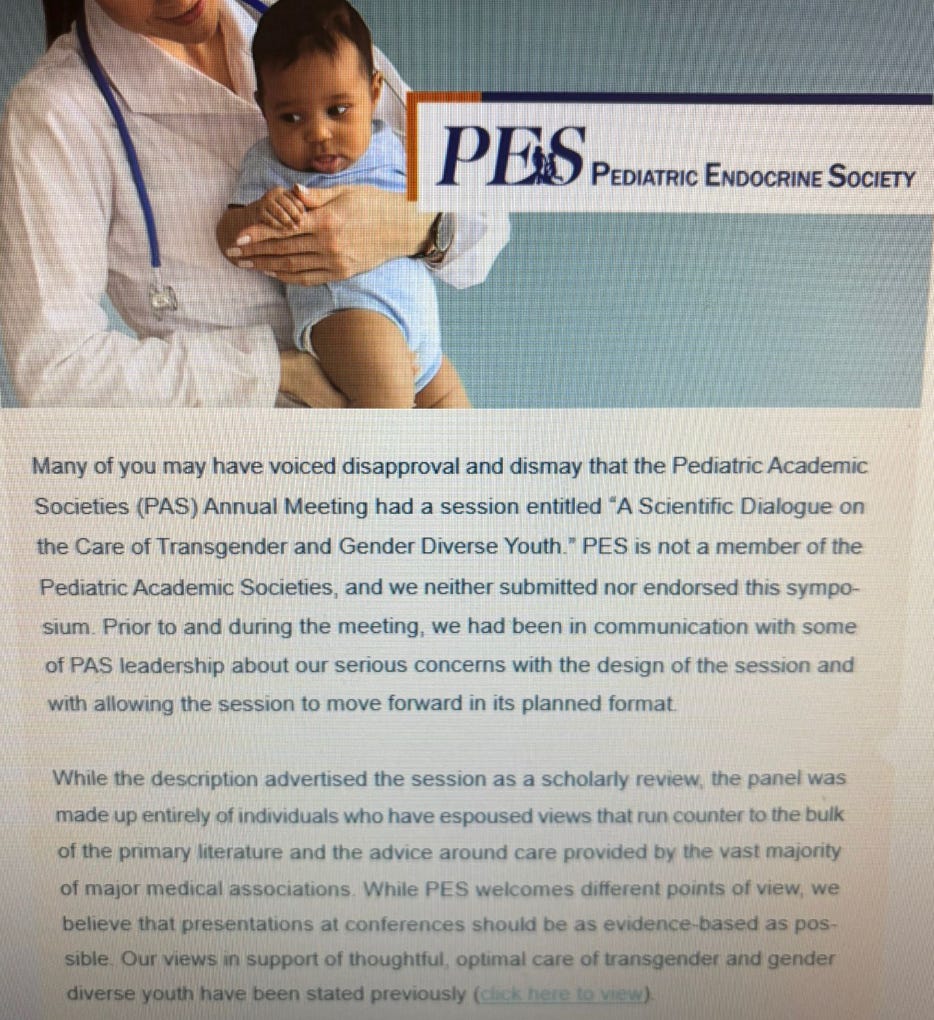
Here, by contrast, is some version of what I think groups could send out when faced with pushback against viewpoint diversity and knowledge expansion:
“We recognize that some people objected to the scheduling of this presentation. As clinicians, though, we always put science and ethics first, especially in a relatively new area of medicine with a weak evidence base. We should be willing to evolve in the face of new evidence and unafraid to reevaluate existing evidence. That is what good scientists and good clinicians do. That is good medicine. We respect every attendees’ right to avoid panels that they aren’t interested in or find irrelevant. However, if you are interested and it is relevant to you, we suggest that you attend the workshop, listen, and ask questions—and propose a panel of your own if you find the answers unsatisfactory. As professionals, we do our best work when we put politics and personal opinions aside. We serve our clients and our colleagues best by modeling robust scientific debate.”
Imagine that there was a presentation on diabetes research, and conference-goers didn’t like the attitudes or beliefs or work of the panelists, who had an important perspective on insulin that, yeah, okay, was different from the guidelines or the American Diabetes Association (which many believe is corrupt, by the way). What would be the harm of hearing it, of attending and asking questions and pushing back or, heaven forfend, being open to and interested in it, even if you were skeptical?
The only potential harm is that you will change your beliefs. That you will have to admit you were wrong. That you will have to face an unbearable well of doubt and discomfort. But if you did, you’d emerge stronger and better able to perform your job. (Why have I switched to the second person? Maybe because I desperately want to preach to the unconverted.)
We can see the destructiveness of clinging to certain beliefs in the panel disrupter’s behavior. He had been convinced that a discussion about best practices for treating gender dysphoria was so dangerous to him, because the modern concept of gender identity relies on the affirmation and participation of all other human beings. The most important thing anyone treating gender identity, or anyone who believes they have a gender identity, needs to do is interrogate that concept.
Doctors, psychologists, and therapists with blinders on and fingers in their ears cannot perform their jobs well, if they’re fending off information instead of absorbing it. When they disrupt instead of listen and push back, they endanger the very clients they want to help. We all want medical care that is “free from bias and rooted in science and good patient care.” Having clinicians who listen to competing perspectives, and are willing to evolve with the evidence, is the best way to get it.
Can I make a language suggestion? I’ve noticed a lack of precision with language that is unhelpful when people say things like “talking about another point of view” “expressing opinions” “debating ideas.” It makes it sound like the information being shared is just random opinions. While opinion is sometimes part of it, a lot of times activists are objecting to is just descriptive information being shared: What sequence of events occurred in Finland, what the Cass report is and says, describing peer reviewed published research papers, etc. I’ve noticed your side does this a lot and it is a mistake that plays into the TRAs hands by characterizing descriptions of facts as just “ideas, opinions, points of view”
Brings to mind the discussion a while ago (on Informed Dissent IIRC) about the “exceptionalism” of gender beliefs and medicine. Yes, in other medical fields we can debate evidence, but not this one.