

Much has been written about how the film The Matrix was the Wachowski sisters’—née brothers—metaphor for transness. Supposedly, the “reality” we’re all living in is a construction, and the truth is experienceable only by way of ingesting the truth serum of red pills, which strip away blue pills’ blissful ignorance. That’s right: you achieve reality by taking a pill that changes the environment to match your mind.
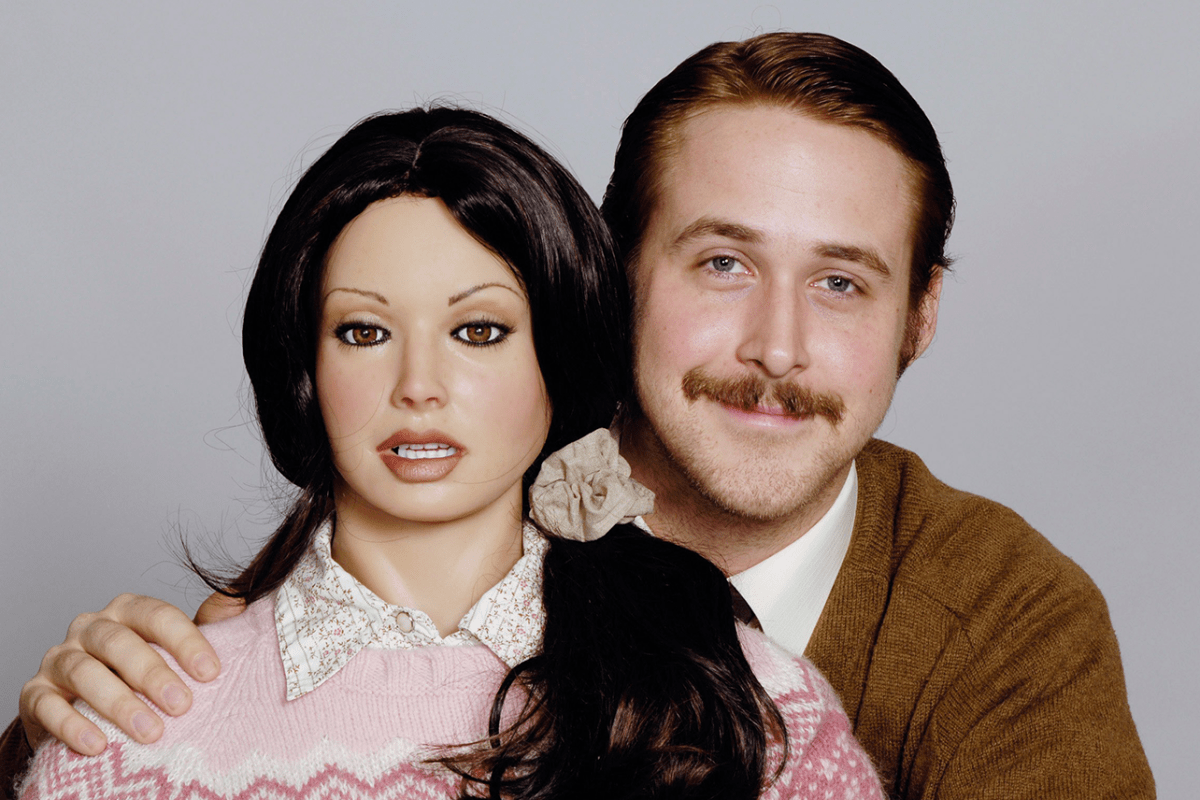
I remember enjoying The Matrix heartily (albeit blissfully ignorant at the time of its coded subject matter, since apparently the atmosphere in my zip code was created by blue pills). But lately I’ve been thinking about the 2007 Ryan Gosling film Lars and the Real Girl—a movie that left me discomfited at the time.
Lars, an awkward loner immune to the reality of the sweet girl crushing on him, buys a “real girl”—a realistic sex doll, though we’re assured that he does not use the sex doll for sex. Instead, the purchase (likely of several thousand dollars) is attributed to some kind of psychotic break. The solution is for the entire town to participatesin his delusion, in hope that it will to help him find his way back to normalcy.
Lars’s lady friend is a disabled latex hottie of Brazilian descent, embraced by the townspeople who shepherd her to social events and school board meetings. I won’t spoil the ending for those of you who want to see it, but I’ll say this: participating in Lars’s delusion doesn’t make his mental illness worse. And it doesn’t lead to legislation elevating the rights of silicone-based bodies above human bodies. Rather, there is a temporary accommodation of abnormality as a mechanism to bring the man back to the world of normalcy.
That, of course, is not what happened with gender identity. Instead, we created a category, gender identity, and a series of rights and protections based around it that elevate it above sex. We asserted gender identity as a fact, rather than an idea, and legislated around it. Those with a gender identity unmatched to their sex were once considered abnormal. The twenty-first century battle to include them within the range of normal changed instead to an assault on the idea of normalcy itself. What we witnessed was not compassion, as Lars and the Real Girl depicted, but psychological anarchy.
The be kind message, the call to compassion, laid the groundwork—not for participating in someone’s delusion to bring him back from it, but to make the delusion into reality. And many people fared worse after the institutionally-inforced compelled participation. Recalling this movie made me wonder what other cultural works helped lay the groundwork for this shift, helping to prepare us for participation we didn’t understand or consent to.
Are there other cultural artifacts you look back on now as a kind of grooming for accepting gender identity?
Personally for me, Orange is the New Black. I just happily swallowed it whole at the time. I was "groomed" to believe that the Laverne Cox character belonged in prison with women. I swallowed the idea, from this sympathetic, attractive and compelling character, that a man could "really" be a woman "inside." Cox was the spoonful of sugar that made this bad gender ideology medicine go down my own throat. I had to unravel that grooming a few years later when I began to learn from US radical feminists about the experiences of ACTUAL women locked up in non-fictional ACTUAL prisons with ACTUAL men who claimed to be women. I learned from the women behind bars themselves that this show was nothing like the hell they were experiencing. That show did a lot of harm. I hate it that I gave my precious time to it.
Yet another compelling take on this issue. Thank you Lisa!