

Democrats' New Gender Strategy: Say Nothing
Ignoring the Donkey in the room

Last week, I traveled with a small delegation of liberals to Washington DC for an event that never in my pre-Trump, pre-gender life would I have thought I’d be excited about: a one-day conference known as WelcomeFest—“the largest public gathering of centrists.”
“Welcome” encompasses three entities—a PAC, a party, and a think tank—that cater to the vast majority of Americans who fall somewhere between extreme left and extreme right. I went to find out what moderate Dems were thinking about gender issues, if they had talking points about boys in girls’ sports or youth gender medicine—and, if they didn’t, if I could offer them information that might serve as building blocks for an off-ramp.
I also went to see if I could practice a desperately needed skill: to gauge whether people are open to discussing this issue, or if they’d hardened into a singular narrative, especially the one that Republicans are using gender identity and trans kids as a wedge issue to gain power. (I’m not saying that might not also be true, but I am saying that Democrats handed them the wedge issue with a garnish on a silver platter.) As I was there as a citizen, not a reporter, I will not be identifying anyone I spoke with privately.
WelcomeFest took place on the first and basement floors of the Hamilton Hotel. Apparently there was some disruption from the far-left last year, because when I arrived—an hour early—the first people I encountered included a small blond woman directing a team of very large black men security guards—who made up the bulk of the conference’s racial diversity. “If a bunch of 18 year-olds with masks swarm, that’s a no,” she said. “Don’t let them in. Although they can still go and buy tickets.”
Before the programming started, I sat myself down in the main room next to a man who funds Democratic candidates in tight but winnable races with Republicans. He told me that nothing we care about—health care, affordability, national security—can be fixed until Trump is out.
“The problem is, there is one thing that is actually better with Trump,” I told him, introducing my raison d’être. Democrats have continued to allow boys in girls’ sports, have promoted a human rights rather than scientific framing of gender affirming care, and have been unwilling to listen to dissenting voices about gender identity from within their own party. Republicans have done the listening—and have taken action.
He assured me that nobody cared much about the issue, and ignored me when I pointed out that, per one poll, the third most-cited reason for not voting for Harris was that she was “focused more on cultural issues like transgender issues rather than helping the middle class.” It was the most-cited reason for swing voters.
I suggested that any Democrat wanting to ensure a win needed to be able to answer the question “What is a woman” correctly—and easily. The funder waved this away as irrelevant, while a man sitting on my other side, who was running for Congress in a small southern city, said the answer to that question depended on who one’s constituents were.
I would have pointed out that that was like saying the shape of the earth depends on where you’re standing, but it was clear that these were not potential allies, and it was an opportunity to practice the skill I was trying to learn: letting go when engaging wasn’t worth it. They had already marked me as a zealot simply because I did care, and because I had a simple, clear answer to my own question: adult human female.
If my seatmates were disappointing, at least many of the conference speakers were inspiring. They noted how clearly Democrats can articulate what they are against: corruption, extremism, Donald Trump—the embodiment of the first two. Moderate Dems are the kinds avoiding terms like BIPOC or LatinX, who don’t have pronouns in their bios—all the signs and symbols and words the modern world requires to signal one’s tribe. In short: the not-woke, not the educated elite who craft the messaging, and increasingly, the policy of the party.
But speakers lamented that moderate Dems struggle to articulate who they are and what they’re for. The centrist wing has watered down messaging, rather than espousing clarity and strength. We should learn from the DSA, not because of their extremism but because they’re proposing solutions at the scale of the problems, and the passion and intelligibility of their messages.
What should we be for? They had plenty of good ideas. Energy, housing, good health care. Imagine what we could have done with the $100 billion for the unauthorized Iran War! We need to legislate around AI; 60% of teachers are using it, but only 18% have had any training on it; those responsible for making our kids globally competitive don’t have the skills to do so. We need to reach parents, concerned about the impact of AI on the economy and on their kids’ futures. Progressive education has largely failed us, despite the good intentions.
And: we need to stop being obsessed with issues most people don’t even understand, and speak for and to the average American. “If we take our messaging from NPR, which is in my opinion a subversive organization, we’re gonna lose elections,” James Carville said. Hallelujah!
The consensus was that Democrats aren’t good at projecting strength, which several pundits noted was our great weakness. If we want to overtake Trump, we have to put forward someone who exudes confidence and might, whom we’d trust with the greatest military force on the planet.
What they were saying without saying it was: Democrats need to man up. They need to project traditionally masculine traits—even the women. Decisiveness, stoicism, independence, leadership, assertiveness. They need to not cave when the mob comes to accuse them of wrongthink.
I nodded along enthusiastically, though I couldn’t yet identify any candidates who embodied these characteristics. One thing I did know: the average American can answer the question “What is a woman?” and it actually takes some strength to do so. This would have been a great segue to get into the gender issue, but almost nobody wanted to go there.
The exceptions were two Congressional candidates from the rural south, Jamie Ager and Bobby Pulido. Bobby said his hairdresser was trans, he knew and loved trans people, but we needed to divide sports by sex, not gender identity. “That’s not hating on LGBTQ,” he assured us. Jamie just said, no, he didn’t want boys in girls’ sports, as if it were obvious, as if it were a given for the Democratic party.
And yet, only two House Democrats, Representatives Henry Cuellar and Vicente Gonzalez, both from Texas, voted for a bill that would have prevented that scenario.
I was beginning to notice a pattern. The only real bite I got was from a DA and her team—all people of color—who represent a very blue city. This makes sense—black Democrats are more likely than white Democrats to say sex is determined by one’s body, not one’s identity. Of the eight Dems who voted for a bill requiring parental notification of gender identity changes at school, five are black or Hispanic. My compatriots at the conference, including one former NPR reporter from the area and a friend from Boston, had some success speaking to one of those black Dems—and emerged, I think, a little more optimistic than I did. I know politics is the slow boring, but I thought by now we’d get some fast boring.
Speakers pointed out that black women and college educated white women are the great deciders of elections, but on gender identity, they may be at odds. In one study, the majority of kids at gender clinics were white, even if the larger “gender diverse” population—those with gender identities unmatched to sex—was racially diverse. If we want to move to the middle, we need to follow black women there.
Or, as Mark Cuban said: “How can we win back the middle? By not being idiots.”
And yet, idiots we continue to be. At the same time that centrists were extolling the virtues of reaching the middle at WelcomeFest, the Senate Committee on Health, Education, Labor and Pensions (HELP) was meeting down the street. The hearing, titled “Protecting Our Children: Exposing the Dangers of Irreversible Gender Transition Procedures on Minors,” was a chance for Democrats to showcase their ability to speak the plain truth.
Alas, Senator Bernie Sanders, ranking member of HELP, was no help at all in that department. He called the hearing “disappointing,” insisting that they were wasting time focusing on “an infinitesimal number of people,” rather than issues like childhood poverty and healthcare. Yes, of course, we should talk about those things. But Democrats were the ones who spent years talking about trans kids and institutionalizing gender identity; they just did it in a way that allowed no discussion or dissent. So yeah, now we gotta talk about it.
He accused Republicans of securing votes by “getting everybody to kind of hate this powerless minority.” Then he offered “the facts when we talk about transgender kids.”
According to two peer-reviewed studies published in the Journal of the American Medical Association, the largest medical association in America, not a single child in our country under the age of 12 has received a transgender surgery. Zero. A grand total of 85 transgender teenagers between the ages of 13 and 17 received a surgery to deal with their bodies and most of these procedures [were] chest related. In other words, boys who had breasts and they were concerned about that etc etc. Less than one-hundredth of 1% of teenagers in America received medications for gender dysphoria and none of these medications went to a child 12 years of age or younger. In other words, Mr. Chairman, we are using precious committee time dealing with an issue that impacts at most less than 100th of 1% of teenagers throughout America and zero kids under the age of 12.
Let’s be clear. The standard of care for transgender youth that my Republican colleagues are attacking today is supported by the American Medical Association, the largest professional association of doctors in our country, and the American Academy of Pediatrics, the largest professional association of pediatricians in our country. What the medical and scientific community tells us is that gender affirming care is associated with a lower risk of depression, severe anxiety, and suicidal thoughts. Bottom line, gender affirming care for youth should be between a doctor, a patient, and their parents, not politicians and the federal government. Not only would banning gender affirming care do nothing to protect kids, it will make it harder for them to get the health care they need. And that would be a tragedy.
Whoo boy, that’s a lot to unpack. I’m not sure the source of Sanders’ numbers, but one thing I do know: it’s hard to get reliable statistics in the absence of long-term follow-up. According to one source, “Between 2017 and 2021, a minimum of 14,726 minors initiated hormone therapy after being diagnosed with gender dysphoria. This number doubled, increasing from 2,905 children in 2017 to 4,231 in 2021.” In Oregon alone, one in 250 girls took testosterone between 2016 and 2023; the state saw a 10-fold increase in girls and 14-fold in boys. Children as young as 8 have been cleared for blockers and hormones, and girls as young as 13 have undergone mastectomies. Medical associations represent their clinician members and have suffered through many a scandal. There is no solid evidence that transition ameliorates depression, anxiety, or suicidality. Banning it isn’t great, but when no medical groups will change course in the face of these realities, there aren’t a lot of other options.
Now, obviously, Sanders is the opposite of a centrist Democrat; he wasn’t even a member of the party until he ran for President. And a slightly more centrist Democrat, Tim Kaine, did manage to drum up some sympathy for detransitioner Chloe Cole, who told her own harrowing story at the hearing.
“Your story is tragic. It is a tragic story,” he said. “It is a classic case as you tell it of medical malpractice.” He called it “outrageous” that she was not “informed about consequences, having your parents told that if they did not consent to the surgery that you would likely commit suicide.” He seemed sure that she would win her lawsuit, though no one else is. Then he proceeded to read a letter from someone thrilled by transition, and compare the fight for trans rights to the fight against systemic racism, slavery and Jim Crow.
Some people who transition feel better after—even in the long-term. But we will never know if they would have felt better anyway. Many people who seek treatment for psychological distress get better eventually, because they’ve sought help at their lowest point; they tend to “regress to the mean.” We have no clear evidence of benefit, and a deep understanding of the risks. We need to make policy based on facts, not feelings. We need to be the grown-ups in the room. We need to man up.
But when it comes to gender, we can’t seem to do so, which is allowing some Republicans to accuse Democratic men—candidates and voters alike—of being too femme to govern, drawing on a resurgence of homophobia. An outlet called The Argument, meanwhile, pronounced centrists dead in the water, before they’ve even set out to swim.
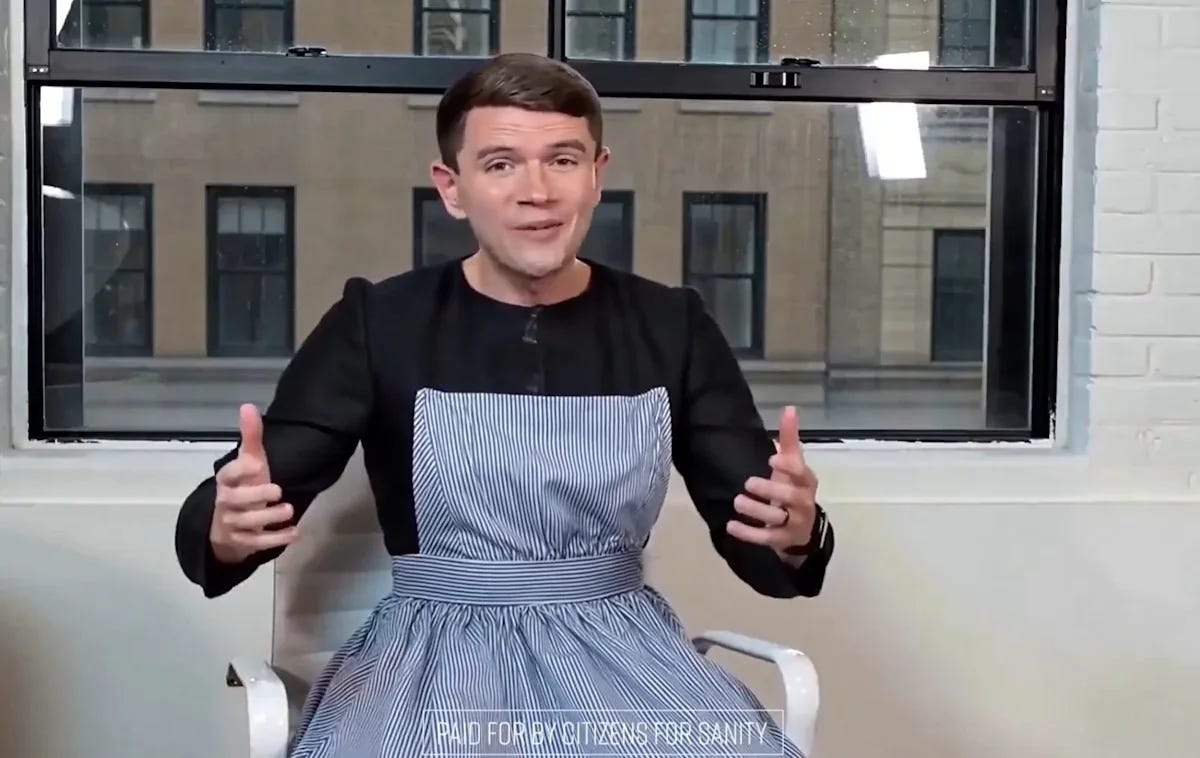


The group ostensibly most poised to face trans issues head one—the moderates—have dismissed the issue, insisted it was a Republican wedge issue, or ignored it altogether. This is not a sustainable approach.
Back at WelcomeFest, I suggested to one of the co-founders that, next year, they have a panel on gender. He cocked his head. “Which one?” he asked. I crinkled my nose in disbelief. “Oh, trans,” he said. But he didn’t agree to such a panel, or refuse one. He did what the rest of them did: he pretended it hadn’t come up.
You touch on it here, but the rhetorical dodge, “why do you care about this, it affects a tiny tiny fraction of people” will never not drive me up a wall.
Entire structures of society were changed for ideological reasons, demands were imposed and were uncritically accepted for that infinitesimal population. They are the party that made this the paramount cause, and now they are hand waving it away as not a big deal. As if it doesn’t even matter because the people to whom this mattered are essentially a rounding error?
Absolutely not!
"powerless minority" ? Is he kidding? This "minority" has managed to get states, schools, prisons, athletics in allowing for biological men to enter women's spaces; bathrooms, locker rooms, all types of sports, women's prisons etc. This has been achieved thru policies and laws along with forced speech. So forgive me to say but Bernie Sanders is doing nothing here but trying to gas light the public.