

Bye-Bye Bamba
The Park Slope Food Co-op, and the Enduring Radical Left
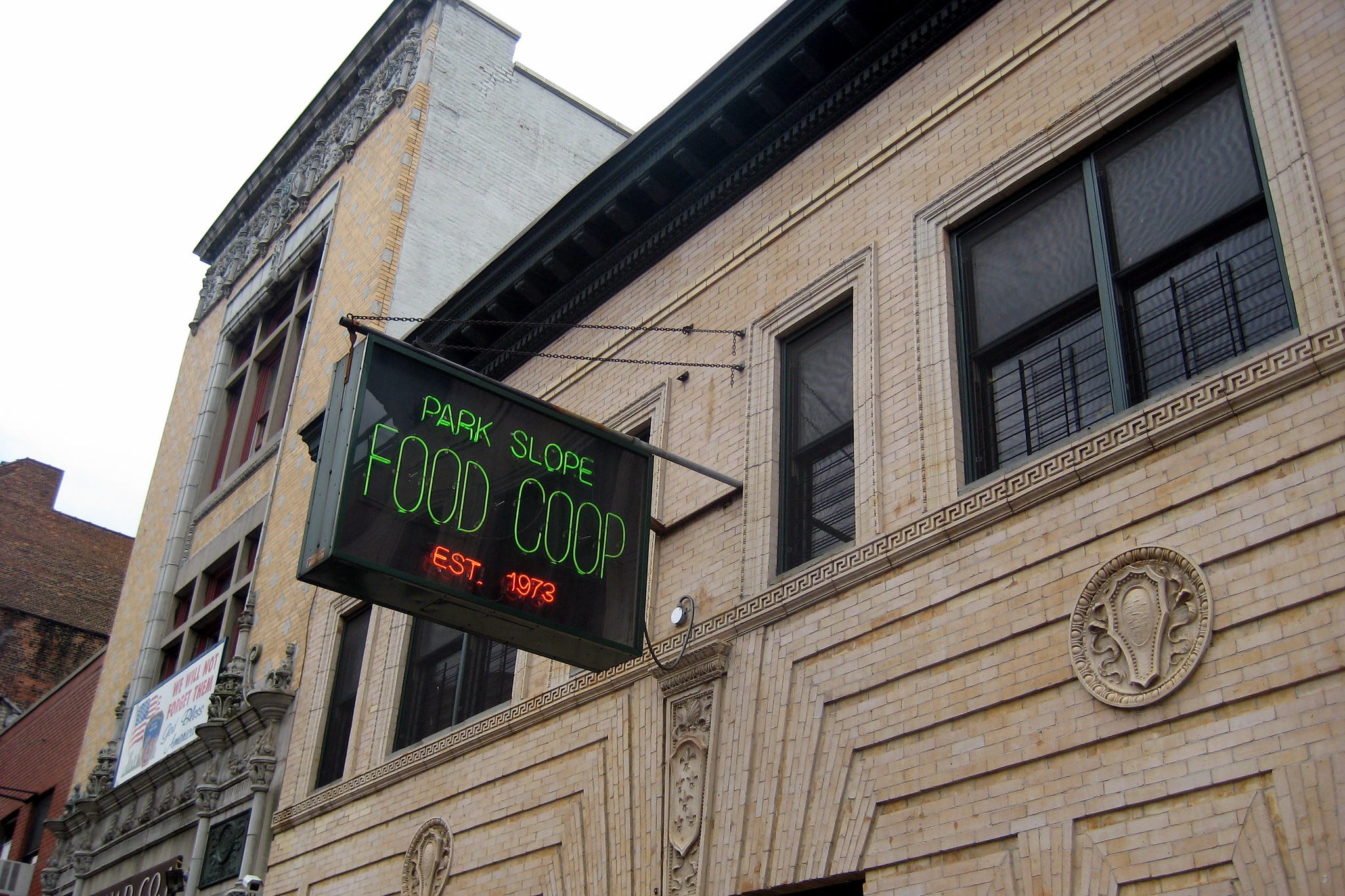
The Park Slope Food Co-op, founded in 1973, is the source of a lot of high-quality, twenty-percent-above-cost produce, as well as the butt of many jokes, due to its overzealous rule-making. The unofficial motto: Scratch a hippie, find a fascist.
No one may shop—or even enter the store—who isn’t a member. The aisles are so tiny that navigating them feels like being a rat in Universe 25. The Co-op offers parental leave, but only after members provide a photocopy of their child’s birth certificate. Since the pandemic, masking is required on Wednesdays and Thursdays, to make some shoppers feel safer—despite the revelation that no solid evidence supported mandatory masking. Everyone over 18 in a household must work a two-hour-and-forty-five minute shift, every four weeks. I joined some thirty years ago, but went on leave for a decade, returning only when my then-boyfriend suggested we sign up as a household, which was nearly as serious a commitment as marriage. Indeed, that boyfriend is now my husband.
The Co-op also has a great selection of products, decent prices, and real community; I run into someone I know every time I go. Most of its 17,000 members have some kind of love-hate relationship with it.
After last night, many of us are probably loving or hating it a little more.
The Co-op carries a handful made-in-Israel products, from tahini to hair mask, which has for years vexed members of the Boycott, Divest and Sanctions Movement—the push to cripple the state of Israel in the name of Palestinian liberation. Since the Hamas attacks on Israel on October 7th, 2023, whether to sell Dorot chopped garlic and Israeli persimmons has been tearing the Co-op apart, serving as a proxy war for tensions within the Left. One member publicly declared a “Jewish Supremacy” problem, echoing Nazi rhetoric, while others have decried the BDS gang’s anti-Semitism. In recent weeks, the Co-op has required extra security, with shouting matches, and sometimes shoving matches, erupting out front.
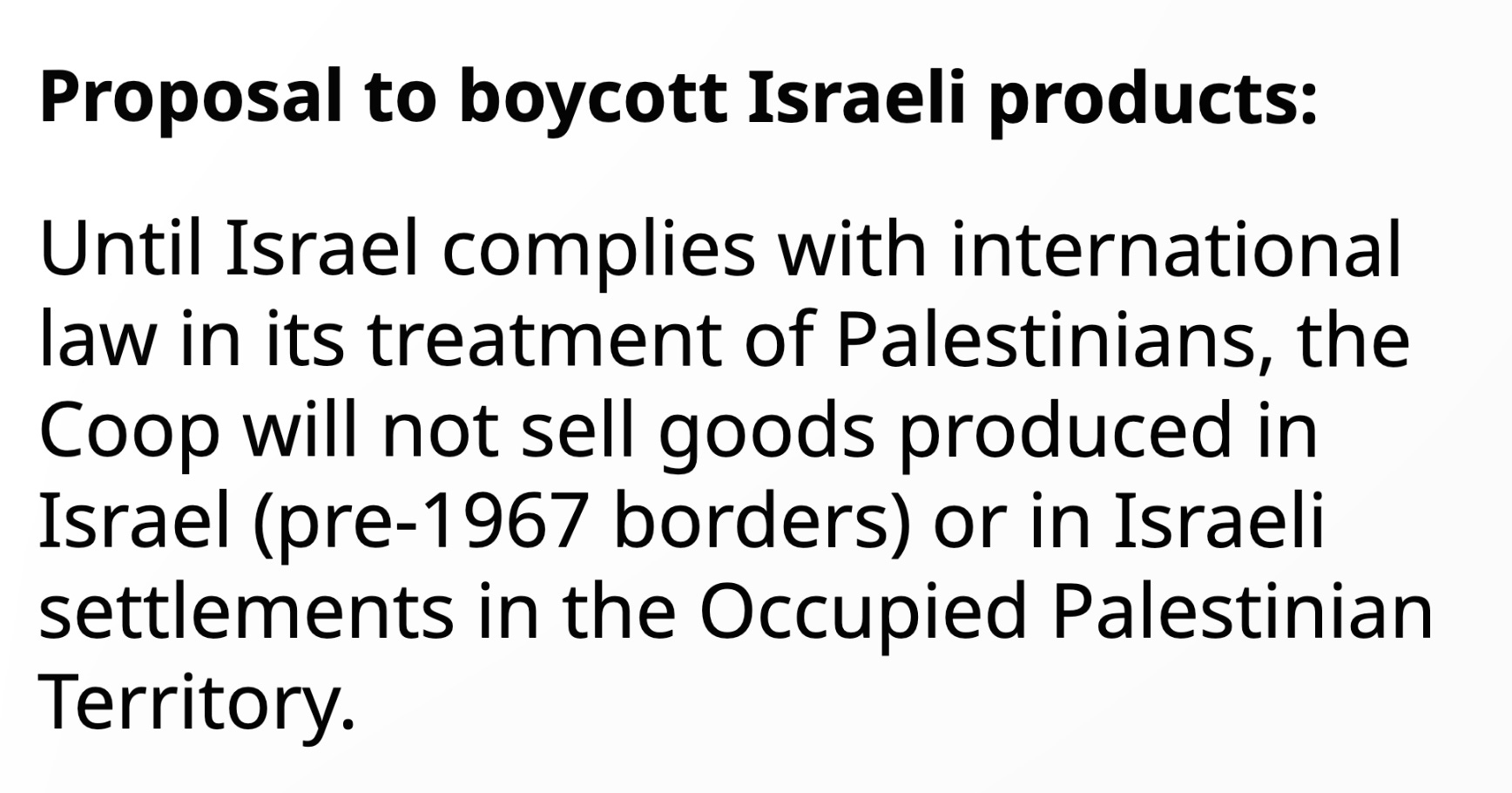
It all came to a head last night, when the normally sparsely-attended—and painfully boring—monthly General Meeting became a media-worthy event, in part because so many people who work in New York media are Co-op members. The kerfuffle centered on two agenda items: a proposal to nix the requirement of a 75% supermajority to pass a boycott, and another, assuming that the first one passed, to boycott Israeli goods. Since nearly 8,500 members registered—as opposed to just dozens at the average meeting—and due to security concerns, management had to make the meeting virtual.
It began, naturally, with a land acknowledgement. The Co-op sits on “the traditional territory of the Munsee, Canarsie, and Lenni Lenape peoples,” meeting chair Josef Szende’s told us. Next up: a run down of Co-op business—inclement weather has affected the stone-fruit harvest, a few notes on electronic shelf labels—which might have been designed to bore members into passivity. I compared it to the infamous DSA meeting, in which no work could be done because each person’s special needs had to be accommodated. My husband had another analogy. “It’s like being in temple,” he complained. “It’s so boring.”
Soon, though, we got to the nitty-gritty: the proposal to change the supermajority to a regular 51% majority, followed by some discussion of pros and cons. A member then suggested an amendment: to move from voting on the proposal at this meeting to voting via referendum—meaning: all members vote, rather than just the third that showed up for the virtual meeting. This seemed like the greatest chance for an actual democratic process, but after what felt like several years’ worth of technical difficulties, the amendment was voted down.
From that moment on, it was clear that the bulk of those who’d shown up to the meeting shared the BDS agenda, and were going to do anything in their power to maintain their advantage—even making sure that the almost two-thirds of members not represented at the meeting didn’t get a say. Likely they understood that, as with a primary election, only the most zealous would vote this way, making it easier to pass what felt to some of us like a radical political agenda. It was like watching Obama amend Title IX in real time, but with a backdrop of organic kale.
Soon after, the resolution passed to remove the necessary percentage for a boycott from 75% to 51.
Next up: a presentation by co-op members about why Israeli products should be boycotted. An elderly woman named Elise Barr—who identified herself as a Jew, and as member number 83—reminded us that the Co-op was not just a grocery store. We’d flexed our political muscle plenty of times before, boycotting products from Pinochet’s Chile, nixing Coca-Cola and grapes. Now, we had the power to “support Palestinian liberation.”
Despite the fact that the BDS team had declared the event to be “the most inclusive and democratic meeting that the Co-op has experienced in its entire history,” what they did next was the opposite: they moved to prevent any discussion and debate about their boycott proposal, and instead proceeded straight to the vote. One meeting organizer said that, in her fifteen years of these events, no one had ever moved to strike discussion from the agenda. But that apparently is the way of the inclusive, democratic BDS team, which also failed to note that some 80 % of the Co-op’s actual staff—a supermajority!—opposed their agenda. Their motion was seconded. None of us with questions or concerns got to say a word. I had my speech about how we needed to ban all American products because of the American Supremacy all ready to go, but alas.
The final tally was unsurprising. Out of nearly 6800 votes, 61% favored the boycott, 38% rejected it, and 1% abstained—which meant that 80 people suffered through a three-hour Zoom only to not weigh in.
Of course, the Co-op has no power to support Palestinian liberation. Cutting off the supply of tahini and Bamba—the main reason Israelis have such low percentages of peanut allergies—does nothing to change the material reality of Palestinians. It does nothing to advance peace in the Middle East. It’s merely symbolic.
What, then, does it symbolize? To many of us, the vote symbolizes the singling out of the sole Jewish state, treating it differently than any other nation doing horrible things. Products from India, where Prime Minister Narendra Modi terrorizes Muslim citizens, still line the shelves. So do products from China, which persecutes Uyghurs. Nobody’s moving to nix the mung beans or organic forbidden black rice. It symbolizes how a radical minority can wield extraordinary power in institutions—even a grocery store in a once hippie-dippy and now tony neighborhood, disproportionately patronized by those who shape media narratives and adumbrate the boundaries of “social justice.” It symbolizes how the furthest left still dominate, and how liberal has ceded to radical.
The Co-op’s mission says that it opposes “discrimination in any form,” and strives “to make the Coop welcoming and accessible to all and to respect the opinions, needs and concerns of every member.” But last night’s meeting showed that it accepts discrimination against those with dissenting views, and doesn’t respect their opinions, needs, or concerns. Cooperating is not symbolically castrating a country whose politics you disagree with. It’s voting with your own dollars, by not buying those products while allowing those who want them to do so.
I admit to being as ambivalent about Park Slope Food Co-op as I am about Israel: I see the need for their existence, but also that they’re riddled with problems. Some might call me an October 8th Jew—someone who felt more connected to Judaism after the Hamas attacks. When people used to ask my grandfather if he was Jewish, he’d say: “Only when they come around for the camps next time.” Until October 7th, I thought that was a joke.
Until last night, I thought Scratch a hippie, find a fascist was a joke, too.
You said it all. Why not boycott ALL the countries doing bad things? Why just this one? And, while they're at it, why not boycott anything made in the US? After all, given the land acknowledgement, they must know what we Americans did to natives, and what we are still doing to them, right? Add to that what our current government is doing to immigrants, and others, and I can't see how we can justify buying US-made goods! What a bunch of hypocrites (and, while I think most are jumping on a bandwagon of the cause de jure, at least a few must be antisemitic, whether they acknowledge it or not).
A great albeit sobering piece, Lisa. It has taken my breath away since 10/7 to see this singular obsessive fixation on Israel on the left as though it's the source of all the evil in the world, when, as you say, other governments are doing despicable things to people, and we don't hear a peep. And yet, there's a turbo-cancerous anti-Semitic rot rising on the political right, too, that I find every bit as repellent, if not more so. What unnerving days.