

A Terrible Tragedy, and a Persistent Pronoun Problem
Forgive the alliteration

At dinner every night during the first few weeks of this school year, my kids would talk about the new teacher: she said this, she wore that. “You know that person is a man, right?” I would ask them. Over the summer, the principal had hired a mask-wearing male math teacher who went by she/they.
Their response: duh. They knew she/they was male. They used the pronouns she/they requested because it was polite to do so. Our conversations were always the same. I’d try to explain why I didn’t think it was polite to ask or demand that other people lie or pretend or participate in someone else’s self-conception that departed from reality, and they’d say: it’s not a big deal. We’re used to this.
Pronouns, to them, weren’t attached to sex. It did not cause them cognitive dissonance to use them this way. Pronouns were more like a nickname. They could kind of see my point of view but also: not really.
I tested their version of reality out myself recently when talking to a mother of a non-binary teen. Soon after we started chatting, I said, gently, “Do you mind if I ask the natal sex of your child?” She told me, and then after that it was easy for me to use they in the conversation without feeling that cognitive dissonance myself. Using those pronouns allowed the conversation to move forward, and it went better than any conversation I’ve had with an affirming parent in the last nine years.
Those are different situations. I still don’t believe it is right to ask children to call a man she/they, but there’s very little I can do about it—other than suing the state of New York for its gender identity protections that violate free speech. (I’m not going to do it, but if you do, let me know.) But in conversation, having some wiggle room can be really helpful.
Where it gets much, much more serious is in anything official, from medical forms to reporting.
When I wrote about Admiral Rachel Levine’s role in pressuring WPATH to remove age limits for pediatric gender medicine, I used she/her. Why? Here’s the big secret: out of habit. I had only known of that human being as Rachel, not Richard, and it didn’t occur to me to use he/him pronouns even though of course I knew Levine is male and always will be. I should either have avoided pronouns altogether or used sex-based pronouns—and explained why I did, since many people are accustomed to identity-based pronouns, and many young journalists have been trained to use them.
The Trans Journalists Association, started in 2020, released guidelines for how to report on trans issues; I’ve put their section on pronouns at the bottom. Here’s what they have to say about reporting on crimes committed by trans-identified people:
reporting on crimes involving trans people
When reporting on crimes that involve or could involve trans people, reporters should seek sources beyond law enforcement. Police often provide inaccurate names, gender identities, and pronouns for victims or those accused or convicted of crimes who may be transgender. Do due diligence if there is reason to believe a story may involve a trans person (see self-identification), rather than assuming the information given in a police report or press release is correct.
That is: don’t listen to any official sources; what matters is reporting accurately the gender identity of the person—even if said person is the perpetrator.
It’s unclear exactly how influential they’ve been, and one podcast revealed that The New York Times refused a training with them. However, as I reported earlier, many of the most influential journalism organizations have partnered with them to tell reporters the “correct” way to report on these issues—which essentially results in embedding bias into the story. We need to grapple with how to shift the norms in reporting again—and what direction to go in.
I understand why many people believe we need an all-sex-based-pronouns-all-the-time policy, especially in reporting. I’ve been willing to carve out exceptions for other kinds of reporting and writing, especially if the writer is occupying the point of view of the subject. But I’ve always believed that in crime reporting, sex-based pronouns are essential. Remember the story of the 83-year-old killer, referred to as she? To not make clear that these perpetrators are male is to obscure the reality of patterns of male violence.
This week, we saw the media and even the police fumble in dispiriting ways. After a young man killed his mother and stepbrother, he went on a shooting rampage in his idyllic-sounding town of Tumbler Ridge, in British Columbia, Canada. The police referred to shooter Jesse Strang as a “gunperson.”
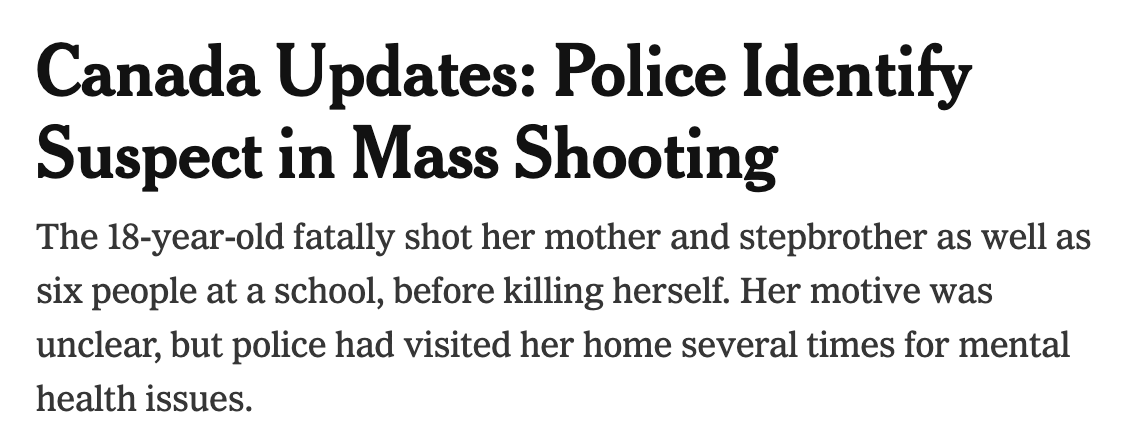
The New York Times used she/her, though later in the story they added that Strang “was biologically born male and began transitioning to female six years ago.” Well, aside from the fact that one cannot become female—though one can think of themselves as a girl or woman, or dress in clothes marketed to them, or undergo medical treatments to appear as female—that was at least a decent start to some kind of shift.
But reporting this way puts liberal media at a disadvantage, when conservative media just comes out and says the truth: this was a deeply troubled young man who committed an unspeakable act of violence and terrorism. We journalists need to not be afraid to say that.
For years I tried to hold an event for journalists about how to understand the science of pediatric gender medicine, how to report accurately but still be sensitive to the subjects you’re reporting on, how to figure out what language to use when words that once carried almost no political meaning are now radioactive with politics. Still hasn’t happened. But we must have discussion and debate and carve out new guidelines. We can’t continue this way.
What are your suggestions for how to report, given how journalists have been trained?
Pronouns
pronoun basics
Last updated Apr 2, 2024
When interviewing a trans source, ask what pronouns they want published. Some sources may request that you use different pronouns for publication than in person. Respect this request. It can be a matter of safety (see never out sources).
Write normally and use pronouns appropriately in stories about trans people. It is both unnecessary and disrespectful to take pains to write around using someone’s pronouns, such as to avoid the singular they. Avoiding pronouns is almost always more conspicuous to the reader than using they/them (see they/them pronouns).
There is never a reason to explain the use of standard they/them, he/him, or she/her in a story when an individual has provided their pronouns.
However, it may be useful to explain why certain pronouns were chosen for publication in situations involving a person whose names, pronouns, or gender identity has been misstated in past coverage, where someone’s gender identity remains unclear, or where the individual’s self-identification has become clearer throughout the course of reporting.
When a source uses less common pronouns, it’s acceptable to add a brief phrase explaining them: Taylor, who uses ze/hir pronouns, attended the event (see neopronouns).
gender-neutral pronouns
Last updated Aug 24, 2023
Use this language to describe they/them and other gender-neutral neopronouns, such as ze/hir and ey/em.
On the history of pronouns:
On language and grammar:
multiple pronouns
Last updated Aug 24, 2023
Some people use multiple sets of pronouns, e.g. an individual who uses both he/him and they/them. Openness to using multiple pronouns is sometimes indicated (such as in someone’s social media profile) with spellings like he/they; this is increasingly common among cisgender people as well. Others may indicate they use “any” or “all” pronouns, which generally means the standard he/him, she/her, and they/them are all acceptable.
Ask the individual which pronouns they prefer to have published. Some may ask to print only one set of pronouns; others may ask for multiple pronouns to be used throughout the story. Depending on the story, the interviewees, and the audience, it may be appropriate to explain the usage of multiple pronouns in different ways.
Sample stories that use multiple pronouns for the same person without an explanation:
You don’t have to constantly take hormones to be trans, 3 people who have gone on and off hormones say from Insider
Nonbinary students aren’t reflected in federal civil rights data. That might change. from Chalkbeat
Sample stories that use multiple pronouns with an appositive or editor’s note:
Living Nonbinary in a Binary Sports World from Sports Illustrated
The Power of Layshia Clarendon from ESPN
neopronouns
Last updated Aug 24, 2023
A neopronoun is a gender-neutral third-person singular English pronoun that is not they/them. Examples include ze/hir, xe/xer, and ey/em. While some trans people use neopronouns in addition to more common pronouns like they/them, it is not appropriate to automatically substitute they/them in place of neopronouns. If unsure of a neopronoun’s spelling or usage, ask; there are variations between similar-sounding neopronouns (ze/zir versus ze/hir).
preferred pronouns
Last updated Aug 24, 2023
Avoid the phrase preferred pronouns. Someone’s pronouns are not a preference, but rather the only appropriate way to refer to that person. (There is no such thing as a “preferred spelling” of someone’s name, for example.) The term preferred pronouns is only appropriate when someone uses more than one set of pronouns and has a preference for one over the other.
singular they/them pronouns
Last updated Aug 24, 2023
Singular they is not unique to trans people and has long been in wide usage as a third-person pronoun for a person of unspecified gender. They used as a singular pronoun still takes a plural verb (such as are, not is) and is otherwise written the same way as the plural they, with one difference: The reflexive pronoun can be either themself or themselves. Themself is clearer in reference to a single person: Bob went to see a movie by themself, as they often do.
It is unnecessary to explain the usage of singular they/them pronouns, given their increasingly widespread adoption. Singular they was added to the Merriam-Webster dictionary in 2019 and its use in news copy has been standard as of the 56th edition of the AP Stylebook.) The singular they is difficult to mistake for the plural unless the sentence is confusingly written. Clarity of language does not preclude using they/them in a story.
English pronouns may be linguistically feminine, masculine, or neutral, but they are not “female,” “male,” or “nonbinary.” Not all nonbinary people use they/them pronouns — many use he/him or she/her. Using gender-neutral pronouns to refer to a person who only uses masculine or feminine pronouns is inaccurate and often insensitive. Likewise, not all people who use he/him are men, and not all people who use she/her are women. Take care to use the appropriate pronouns for everyone in news coverage and reporting interactions.
what to do if you can’t determine someone’s pronouns
Last updated Aug 24, 2023
Do not avoid using a person’s name or pronouns in a story simply because that person is transgender or nonbinary. Write around pronouns only if it is impossible to determine the right pronoun from someone’s personal identification, e.g. an unidentified person, a person whose gender identity is uncertain, or a trans person whose pronouns are not publicly available (see identifying transgender people during breaking news). Some publications consider singular they an appropriate substitute for an unknown person, while others may prefer writing around pronouns or gendered identifications entirely.
As British feminist, Jane Clare Jones puts it, “The only pronouns one can prescribe to oneself, ethically, are 'I' and 'me.' Third-person pronouns are granted to you by another person.”
When I heard the news the other night about the terrible shooting in Canada, and they announced it was a female shooter, my first thought was bullshit! For various reasons, including the fact I am a therapist, I have been very interested in what leads a person to engage in a school shooting. But even if you don't have my curiosity or professional interest and experience, you are probably aware that these horrible events are typically perpetrated by young males. The last few years have added a new characteristic to the profile - transgender. What makes me furious about the mainstream media's and law enforcement's insistence of sidestepping the trans angle with their pronoun (she/her) and other semantic acrobatics ("gunperson") is that they are perpetuating the illusion that their trans identity had nothing to do with their violent act. The reality is that these young people have been troubled for a while, and there have been opportunities to intervene, but they have been missed by parents, teachers, peers, etc who affirmed them out of a belief it's a human rights thing, rather than see the trans identity as a symptom of a deeper issue and comorbid issues - depression, trauma, social ostracism, troubled family life, autism, participation in extremist online groups, built-up rage against a school system where they felt imprisoned & bored, substance use, ADHD meds, anti-anxiety meds, cross-sex hormones, screen addiction... I often tell teens that they are the first ones to know when a peer is "off" - but if we don't talk about this stuff as adults, out of a fear of being politically incorrect, how the heck are kids going to understand? And if police and journalists are not going to accurately describe profiles of these shooters, and help the general public understand them better, but instead focus on gun control, we will keep having these tragic events.